Information as of October 2026.
New here? Please read Start Here first. It explains who I am, and what the colored boxes and speech bubbles in this guide mean.
The other day, I was sitting in a sauna, sweating, and thinking about nothing in particular. Then this thought popped into my head:
Japanese baths have so many manners that nobody ever writes down.
We Japanese just know them. But I can’t remember anyone actually teaching me. I copied my parents. I watched the people around me. That’s about it.
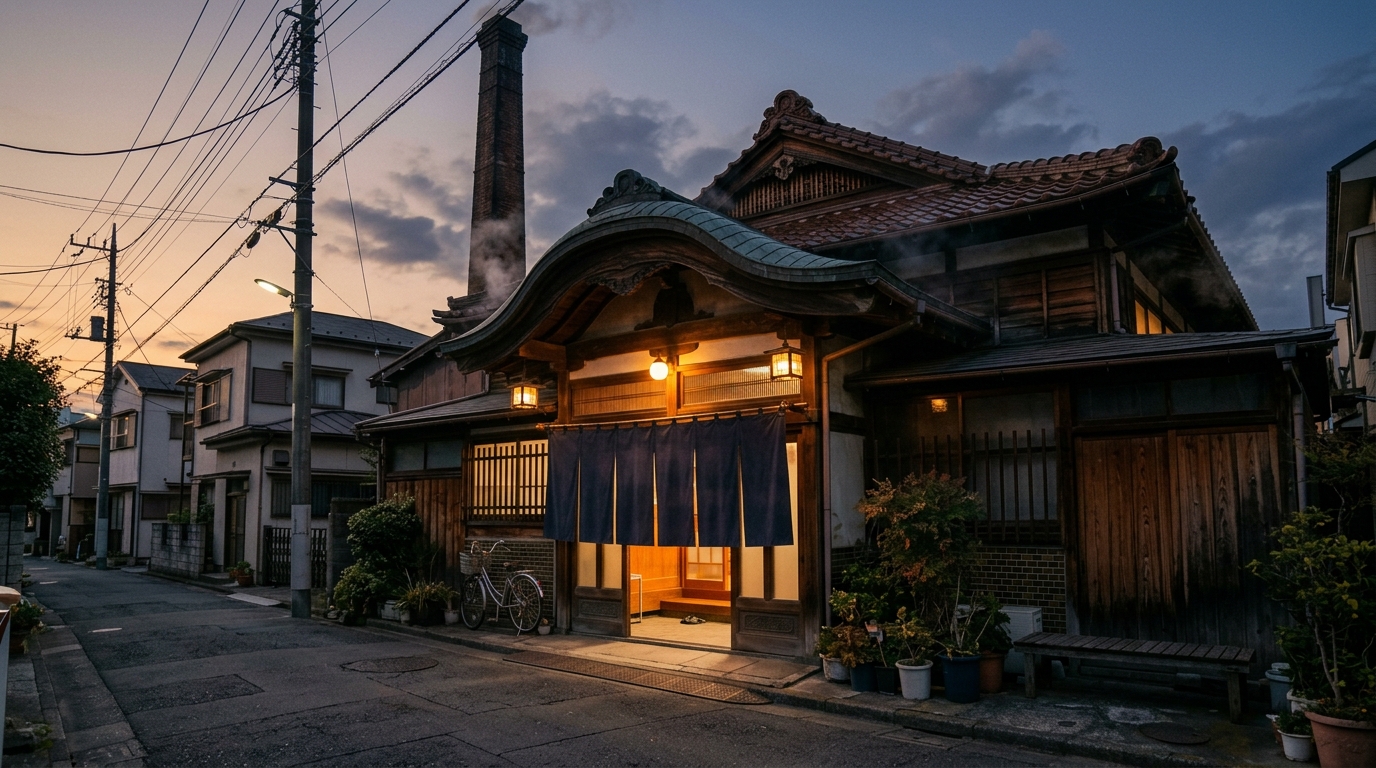
So what about someone who just arrived in Japan? I imagine a lot of people freeze for a second in front of that cloth curtain at the entrance.
This guide walks you through a sento (a Japanese public bath) from the moment you arrive until you walk back out. I’ll also tell you the moments where I got confused, because you’ll probably get confused there too.
- What is a sento?
- How to find the men’s and women’s entrance
- How to use the shoe locker
- How to pay at a sento
- How to use the changing room
- How to wash before you get in the bath
- How to enter the bath
- How to finish up and leave
- For visitors from abroad
- Quick summary: how to use a sento
- When things go wrong
- Cheat sheets you can use right away
- FAQ
What is a sento?
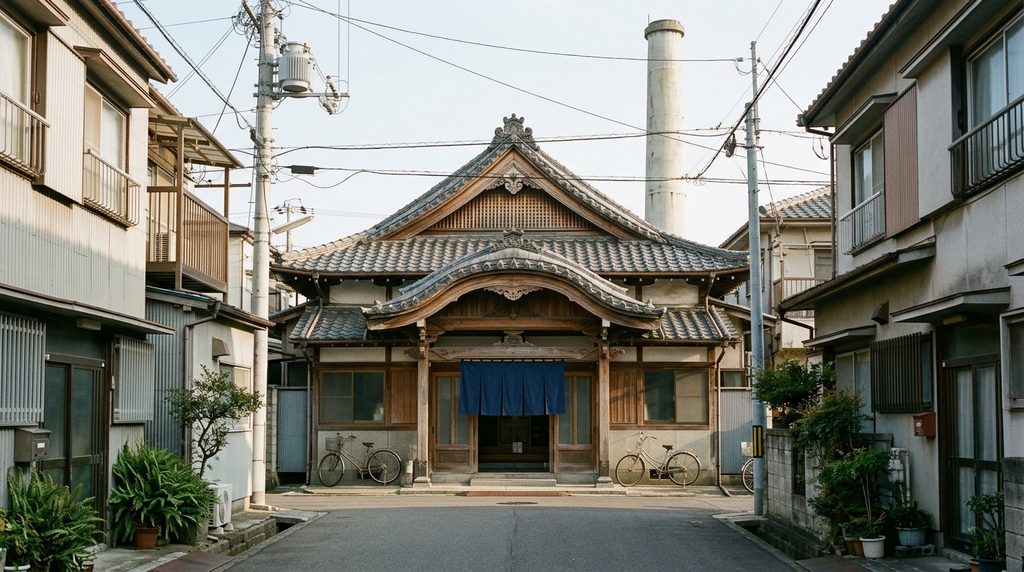
A sento is an old-style neighborhood bathhouse. Back when most homes didn’t have their own bath, people went almost every day.
There are far fewer now. In the 1970s there were more than 16,000 sento across Japan. Today there are fewer than 3,000. Tokyo still has around 400. If you’re walking through a residential area and suddenly see a tall chimney, that’s probably a sento.
How much does a sento cost?
It’s cheap. In Tokyo, an adult pays 600 yen (since August 2026).
That’s because sento are treated as “public baths” under Japanese law, and each prefecture sets a maximum price. Right now the highest is 600 yen, in Tokyo and Osaka. The lowest I found, in a national list from May 2025, was 300 yen in Yamagata. The same kind of bath can cost twice as much depending on where you are.
Super sento (big, modern bath complexes) and onsen (hot springs) are different and usually cost more.
How to find the men’s and women’s entrance
Check the noren. Read the character, not the color.
The very first thing to do is find the right entrance. Get this wrong and things get very awkward the moment you step through.
The entrance has a noren, a cloth curtain with characters on it.
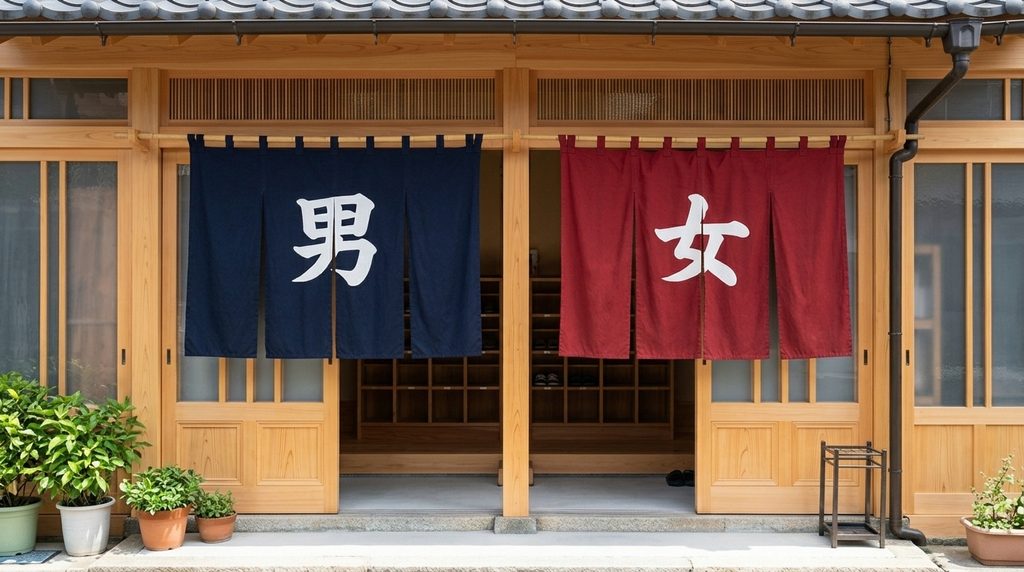
- 男 means men’s bath (otoko-yu)
- 女 means women’s bath (onna-yu)
Men’s noren are often blue or navy, and women’s are often red or pink. But that’s not a rule. Some places use the same color for both, or completely different colors.
A small trick: 男 is made of 田 (rice field) and 力 (strength). A person who does heavy work in the rice field. Once you know that, it’s a little easier to spot.
Some noren just say ゆ (yu) in big letters. That simply means “hot water,” not men or women. In that case, the entrances usually split further inside, so look for signs above or next to the doors.
Some sento swap the men’s and women’s sides on different days. Check every time.
Don’t assume it’s the same side as last time. If you really can’t tell, just ask at the front. (There’s a phrase card at the end.)
How to use the shoe locker
Take off your shoes at the entrance and keep the wooden key with you.
Once you’re through the noren, take off your shoes and put them in the getabako, the shoe locker.
Traditional sento often use a wooden board as the key, called a kifuda. Put your shoes in, pull out the kifuda, and that’s your key. You’ll need it to get your shoes back.


I have a soft spot for these wooden keys. They have a charm that’s hard to describe. Honestly, I’d love to take one home. (You can’t. Please don’t.)
How to pay at a sento
Pay first, on your way in.
The first time I went to a sento, the first thing I wasn’t sure about was when to pay. When I come in? When I leave?
At almost every sento, you pay first. Where you pay depends on the place:
- Bandai: a raised seat between the men’s and women’s entrances. You hand your money to the person sitting there. Common at old-style sento.
- Front desk: a regular reception counter near the entrance. Common at newer or rebuilt sento.
- Kenbaiki: a ticket machine. Buy a ticket, then hand it to the staff.
Many sento also sell or rent towels and soap here. A sauna is often an extra charge.
How to use the changing room
After paying, go to the datsuijo, the changing room, and take off all your clothes.
There are usually two types of storage:
- Lockers with a key: the key is on a rubber band, so you can wear it on your wrist or ankle into the bath.
- Open shelves with baskets: common at old-style sento. There’s no lock, so ask at the front if they can keep your valuables.
Use any empty locker or basket, but never touch one with someone else’s clothes in it.
Unless the staff gives you a number, you can use any empty space. (Opening the wrong one by accident happens to everyone. Just close it quietly.)
Keep your clothes neatly inside your own locker or basket.
The changing room is small and shared, so the idea is “leave it nice for the next person.”
No photos in the changing room or the bathing area.
This is banned at almost every sento. Leave your phone in the locker, along with your big towel. Take only a small towel and your soap inside.
How to wash before you get in the bath
First, look up: the Mount Fuji painting
When you open the door, look at the wall straight ahead.
The classic sento image is a huge painting of Mount Fuji covering the whole wall. Soaking in hot water while looking at a giant Mount Fuji. That’s the sento experience.
These are either penki-e (painted directly on the wall) or tile-e (made of small tiles). Some show the sea, pine trees, or sailing boats instead of Fuji. No two are the same.
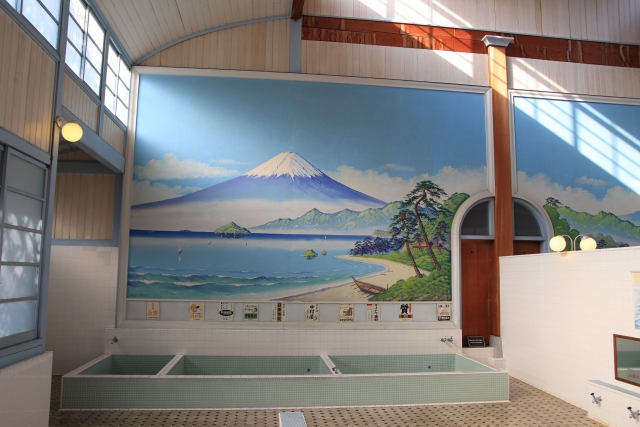
What view you’ll get is a surprise until you open the door. Take your time and enjoy it.
Kakeyu: rinse before anything else
Never get straight into the bath. Pour hot water over yourself first.
This is called kakeyu. If there’s a kakeyu spot, use that. If not, scoop hot water with a bucket (oke) and pour it over your body, starting from your feet. Crouch down so you don’t splash the people around you.
The washing area
Near the entrance of the bathing area, you might see a shelf of small baskets with shampoo in them.
The shampoo baskets on the shelf belong to other customers. Don’t use them.
They’re regulars’ personal things, not the sento’s. If you bring your own shampoo, you can leave it there too.
Sit down on a stool to wash your body and hair.
Washing while standing sends soap flying onto your neighbor.
Each spot has a mirror, a shower, and a karan (a tap for hot and cold water). At many sento, you press a button and the water runs for a few seconds, then stops by itself. Just press it again.
Keep the shower low and pointed at yourself, so you don’t spray the person next to you. You can also fill the bucket from the karan and pour it over your head. Very sento.
When you’re done, rinse the stool and turn the bucket upside down.
Again, it’s for the next person.
How to enter the bath
Now, finally, the bath.
Why all those steps first? Because in Japan, the water in the bath is something everyone shares. That’s why you wash before you get in, why your towel stays out of the water, and why long hair is tied up. Most bath manners come from this one idea.
Keep your towel and your hair out of the water.
Put your towel on your head or on the edge of the bath. Tie up long hair.
No swimming, and keep your voice down.
Fair warning: most sento water is hot. And how hot changes a lot from place to place. Old-style sento in Tokyo tend to be especially hot. If you can’t stand it, don’t push yourself.
Sometimes I put one foot in and go “HOT!!!” To me, feeling how hot each sento runs is part of the fun. Part of me secretly enjoys that “HOT!!!” moment.
Don’t add cold water to a bath other people are in.
Some regulars come exactly because they like it that hot.
How to finish up and leave
Dry off before you go back to the changing room
Dry yourself in the bathing area before you step into the changing room.
If there’s a shower near the exit, give yourself a quick rinse first.
Surprisingly few visitors know this one. If you walk out dripping, the changing room floor gets wet and the next person might slip. Wring out your small towel hard, wipe yourself down quickly, then step out. That’s the sento way.
The after-bath drink
Once you’re dressed, here’s the last treat: a drink after the bath.
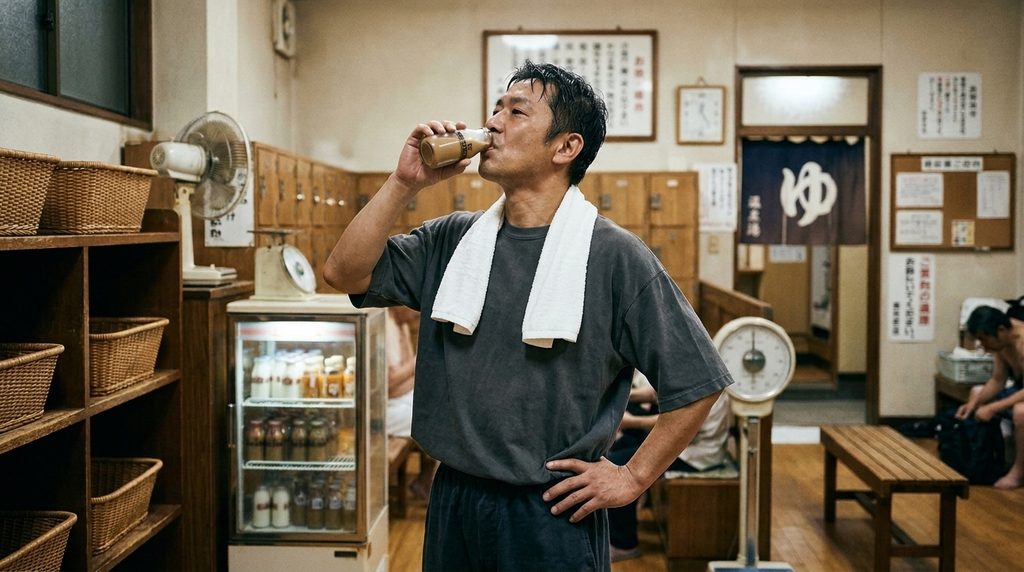
Many sento have a fridge with milk in glass bottles. Drinking milk after a bath is a long-loved Japanese habit. There’s even a classic pose: one hand on your hip, drink it all in one go. (That’s half a joke. But people do it.)
I’m a coffee milk guy.
Leaving
Go back to the shoe locker, put the kifuda back in, and the door opens. Check you haven’t forgotten anything, and step back out through the noren.
For visitors from abroad
More sento now welcome visitors from other countries. Tokyo and the Tokyo sento association ran a campaign called “WELCOME! SENTO,” which introduced bathhouses with English guides and towels and soap ready to use. The campaign has ended, but the official site still explains sento manners: welcome-sento.com
About tattoos (Varies): news reports say Tokyo sento don’t turn people away for tattoos as a blanket policy. But it depends on the place, so check the sign at the entrance or ask at the front.
Quick summary: how to use a sento
- STEP 1Read the noren.
男 = men, 女 = women. Don’t go by color. Some places swap sides by day.
- STEP 2Take off your shoes and put them in the getabako.
Keep the wooden key (kifuda).
- STEP 3Pay at the front.
Bandai, front desk, or ticket machine. Towels and soap are often sold here. Sauna is often extra.
- STEP 4Undress completely in the changing room.
Any empty locker or basket is fine. Don’t touch other people’s things. No photos. Take only a small towel and soap inside.
- STEP 5Do kakeyu.
Pour hot water over yourself, crouching, without splashing others.
- STEP 6Sit down and wash your body and hair.
Shower low, pointed at yourself.
- STEP 7Clean up.
Rinse the stool, turn the bucket upside down.
- STEP 8Get in the bath.
Towel out of the water, long hair tied up. No swimming, no loud talking. If it’s hot, go in slowly from your feet.
- STEP 9Dry off inside the bathing area.
Do it before you go back to the changing room.
- STEP 10Get dressed and enjoy the after-bath.
Milk, a rest, and some water.
- STEP 11Use the kifuda to get your shoes, and head home.
Prices (as of October 2026)
- Tokyo (from August 1, 2026): adults (12+) 600 yen / children 6–11 200 yen / under 6 100 yen
- Saitama (from April 1, 2026): adults 550 yen / children 200 yen / under 6 100 yen
These are the maximum prices set by each prefecture, and most sento charge exactly this. Prices differ by region and can change, so check the sign at the sento.
When things go wrong
Say “Otona hitori” (one adult) or just hold up one finger. That usually works. You can also show the phrase card below on your phone.
Plenty of sento don’t put soap in the bathing area. Go back to the changing room (dry off at the exit first). At a bandai-style sento, you can sometimes call out to the person at the bandai and buy some. At a front-desk sento, you’ll need to get dressed and go to the front.
Next time, make your own little “sento kit.” A small pouch with shampoo, body soap, and a towel means you can go whenever you feel like it.
And remember: the baskets on the shelf near the entrance are other customers’ things. Don’t borrow from them.
You don’t have to tough it out. If there’s a cooler bath, use that one. If not, just soaking your feet is fine. Just don’t add cold water to a bath others are using.
Walking around with your small towel in front of you is totally fine. Some people don’t bother. Either way, nobody is really looking. Everyone is busy enjoying their own bath.
It might be a denki-buro, an “electric bath” with a weak electric current in the water. If you have a heart condition or a pacemaker, do not go in. There’s usually a warning sign near it.
The bathing area is full of steam, so glasses fog up instantly. If you truly can’t see without them, you’ll have to wear them. But if you can manage, take them off in the changing room.
You may have stayed in too long. In Japanese this is called noboseru. Get out of the bath right away, sit down, rest, and drink some water. Most locals stay 30 minutes to an hour in total.
Cheat sheets you can use right away
1. Phrase card for the front desk
Save this to your phone and just show the screen.
One adult, please.
大人1人、お願いします。
Otona hitori, onegaishimasu.
Do I pay first?
お金は最初に払いますか?
Okane wa saisho ni haraimasu ka?
Which one is the men's bath? / the women's bath?
男湯(女湯)は、どちらですか?
Otokoyu (Onnayu) wa, dochira desu ka?
Can I rent a towel?
タオルを借りられますか?
Taoru o kariraremasu ka?
Where can I buy shampoo and soap?
シャンプーと石けんは、どこで買えますか?
Shanpū to sekken wa, doko de kaemasu ka?
Can you keep my valuables?
貴重品は預かってもらえますか?
Kichōhin wa azukatte moraemasu ka?
I'd also like to use the sauna.
サウナも使いたいです。
Sauna mo tsukaitai desu.
I have a tattoo. Is it OK to enter?
タトゥーがありますが、入っても大丈夫ですか?
Tatū ga arimasu ga, haitte mo daijōbu desu ka?
2. What to bring
If you bring your own
- Small towel (hand towel size)
- Large towel
- Shampoo and body soap (your “sento kit”)
- Change of clothes (especially underwear)
- Cash (coins help; hair dryers often cost extra)
- Plastic bag (for your wet towel)
- Hair tie (for long hair)
If you go empty-handed
- Cash (entry + towel and soap)
- Change of clothes (especially underwear)
- Plastic bag
You can buy or rent towels and soap at the front at most places. Some don’t offer them, so ask with the phrase card if you’re unsure.
3. The 10-second check before you enter the bathing area
- All my clothes are off
- Big towel is in the locker
- Locker key is on my wrist or ankle
- Phone is in the locker
- Long hair is tied up
- Glasses are off (if I can see okay without them)
- Order: kakeyu → wash → bath
FAQ
- QCan I go in if I have a tattoo?
- A
Sento are often easier than other baths. News reports say Tokyo sento don’t refuse tattoos as a blanket rule. But some places do. Check the sign at the entrance, and if you’re not sure, ask before you pay.
- QCan I go in during my period?
- A
Please don’t get into the shared bath. Many people use the same water. If you’d like to use only the showers, ask the staff.
- QCan I bring my kids?
- A
Yes. But the age until which a child can go into the bath of the opposite sex with a parent is set by local rules. In Tokyo, for example, children aged 7 and over can’t enter the opposite sex’s bath. It differs by area, so ask the staff.
- QCan I wear a swimsuit?
- A
No. Nobody wears a swimsuit at a sento. Everyone bathes naked.
- QDo I have to be Japanese to go?
- A
Not at all. Sento are for anyone in the neighborhood, and that includes you. Just follow the steps above and you’ll fit right in.
I’m Japanese, and I write my drafts in Japanese with help from AI to turn them into natural English. The experiences here are my own. Some photos are AI-generated. If something is unclear, please tell me through the Contact page.
I also write about Japanese manners in Japanese on note: note.com/enjoyjapan
Sources
- Ministry of Health, Labour and Welfare, “Overview of the Public Bath Act” https://www.mhlw.go.jp/stf/seisakunitsuite/bunya/kenkou_iryou/kenkou/seikatsu-eisei/seikatsu-eisei04/04.html
- Tokyo Metropolitan Government, public bath price limits https://www.shouhiseikatu.metro.tokyo.lg.jp/chousa/yokujyo/touseigaku.html
- Nerima City, bath prices https://www.city.nerima.tokyo.jp/kankomoyoshi/event/sonota/yokuzyou/nyuuyokuryoukinn.html
- Saitama Prefecture, public bath price revision https://www.pref.saitama.lg.jp/a0706/news/page/news2026022401.html
- Okayama Prefecture, national list of public bath price limits (as of May 31, 2025) https://www.pref.okayama.jp/uploaded/attachment/393282.pdf
- Hyogo Prefecture, national list of public bath price limits https://web.pref.hyogo.lg.jp/kf14/nyuuyoku_ryoukinn_kyougikai/documents/r7_7_kanren_shiryou.pdf
- Shinjuku City, public baths (age limit for mixed bathing) https://www.city.shinjuku.lg.jp/seikatsu/file02_04_00002.html
- Unseen Japan, “Tokyo’s Sento Tourism Campaign” https://unseen-japan.com/sento-tokyo-tourism-campaign/
コメント