


Information as of October 2026.
New here? Please read Start Here first. It explains who I am, and what the colored boxes and speech bubbles in this guide mean.
Japan is in a bit of a sauna boom right now. Most sento and super sento have a sauna, and more and more places are built around the sauna itself. Some people even call going to the sauna “sakatsu” (sauna activity).
I love saunas and go often. But at first, I didn’t understand half of what was going on.
Saunas have plenty of unwritten manners too. In this guide, I’ll walk you through a Japanese sauna and share, honestly, the places where I stumbled.
Before the sauna, you wash your body just like at a sento. If you haven’t been to one yet, start with How to Use a Japanese Sento.
This guide is about saunas inside public baths such as sento and super sento, where you go in naked. Mixed saunas where you wear a sauna suit or swimsuit, and tent saunas, have their own manners that this guide doesn’t cover.
- How to use a sauna mat
- Where is the best seat in a Japanese sauna?
- What are löyly and Aufguss?
- How to use the cold bath
- How to rest after the sauna: gaikiyoku
- What does “totonou” feel like?
- TV and chatter are part of the sauna too
- Quick summary: how to use a Japanese sauna
- When things go wrong
- Cheat sheets you can use right away
- FAQ
- Read next
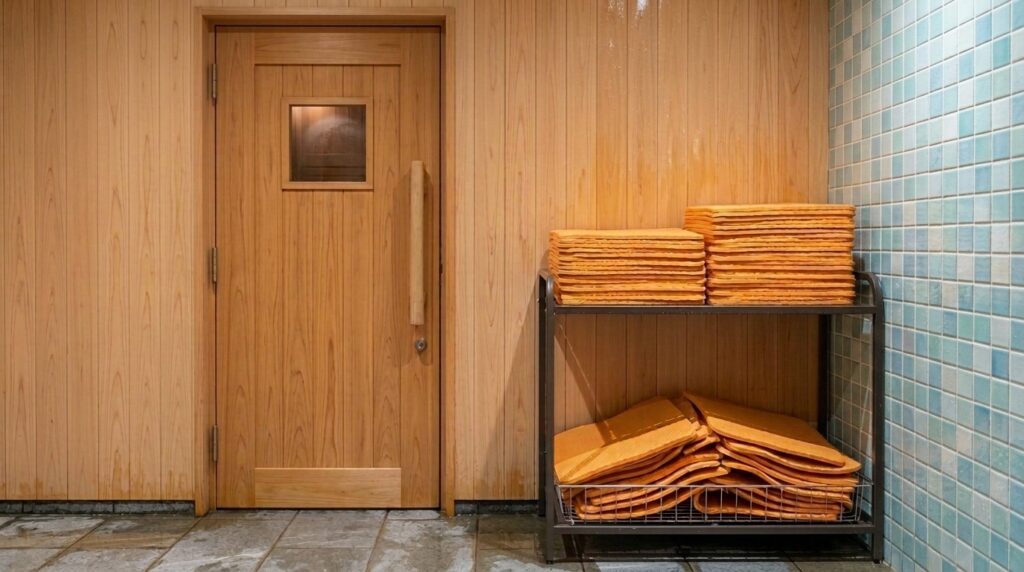
How to use a sauna mat
You’ll often see a stack of sauna mats by the sauna door. A sauna mat is a small mat or towel you sit on, so your sweat doesn’t get on the bench.

The first time I saw them, I didn’t know if I was allowed to use them. And there were two places: a shelf of clean mats and a basket of used ones. Which one was which? I couldn’t tell right away.
Sit on a sauna mat or your own small towel, not straight on the bench.
The mats by the door are usually free for customers to use. Take one from the clean shelf, spread it out inside, and sit on it. When you leave, take it with you and drop it in the used basket.
If there are no mats, sit on your own small towel.
If you see something that looks like mats by the sauna door and you’re not sure how they work, get into a nearby bath first and watch the other customers. What do people do with the mat when they go in, and when they come out? If you warm up in the bath and watch for a bit, you’ll usually figure it out.
Where is the best seat in a Japanese sauna?
Japanese sauna rooms usually have benches in steps, like bleachers. The higher you sit, the hotter it gets, because hot air rises.
Seats close to the sauna stove (a heater piled with hot stones) are very hot too.
One day I walked into the sauna, and a group of older men I didn’t know called out to me: “Hey, young man, you can sit there!”
I thanked them and sat down. Later I realized it was the seat right next to the stones. The hottest seat in the room.
For sauna lovers, the hottest seat is the best seat. And they gave that “best seat” to a young stranger. My head was foggy from the heat, but I remember feeling warm inside, and not just from the sauna.
This isn’t only about saunas, but I hope you’ll remember it: when there’s a good spot or a good thing, share it instead of fighting over it.
If it’s your first time, start on a lower bench. Move down anytime if it’s too hot.
Nobody minds if you move. If someone kindly offers you the hot seat and it’s too much, just say thank you and move down.
What are löyly and Aufguss?
Pouring water on the hot stones to make steam is called löyly (rouryu in Japanese). It’s a Finnish word. The moment the water hits the stones, there’s a hiss and a wave of hot steam fills the room.
If you’re sitting near the stones, it really makes you jump. I thought I had the “best seat,” and suddenly my face was burning. …The best seat?
Some places let customers pour the water themselves. This is called self-löyly.
Before you pour water on the stones, ask the people around you.
The room suddenly gets much hotter, and not everyone wants that. A simple “Rouryu shite mo ii desu ka?” (May I pour water?) is enough. If someone asks you, “Dōzo” (go ahead) is fine.
Follow the shop’s limits on how much water and how often.
Many places post a rule, such as 2 to 3 ladles every 5 to 15 minutes. Check the sign near the stove.
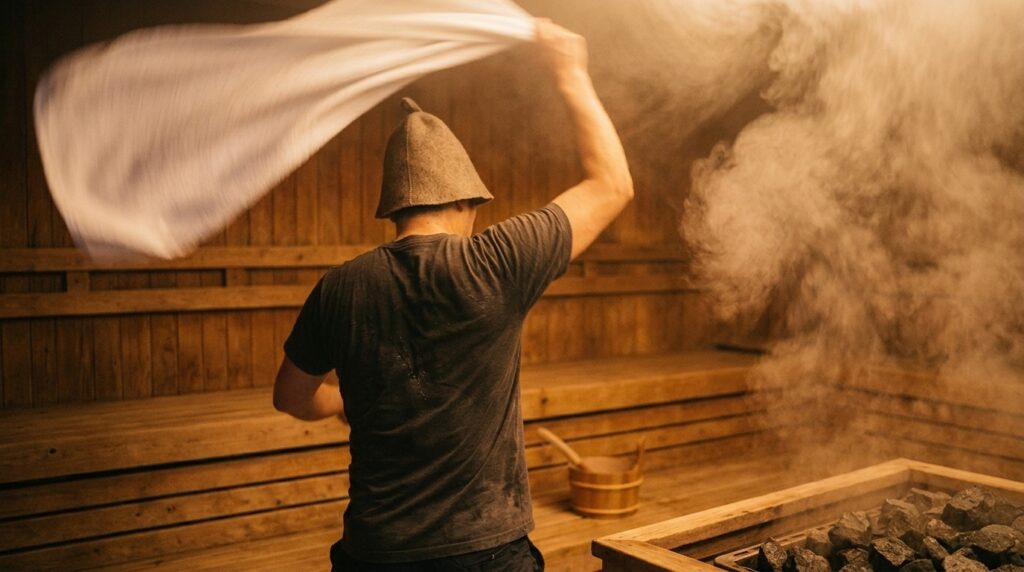
There’s also an event called Aufguss. A staff member pours water on the stones, then waves a big towel to send hot air at everyone. The person waving the towel is called a neppashi (heat master). It’s seriously hot. But when it ends, people often start clapping. It’s a bit like a small show.
You can leave during Aufguss. Open and close the door quickly so the heat stays in.
Many places don’t have löyly or Aufguss at all. Aufguss also often runs only at set times or on certain days. If you want to try it, check the shop’s website or the signs before you go.
How to use the cold bath
After a good sweat, it’s time for the mizuburo, the cold bath.
Rinse off your sweat before you get into the cold bath.
To be honest, I skipped this once. The water for rinsing felt cold and I didn’t like it. “I’m getting into cold water anyway…” I thought, and went straight into the cold bath, sweat and all.
Afterward I thought, yeah, that was wrong.
The cold bath is shared, just like the hot bath. If you go in sweaty, the water gets dirty for everyone.
If you don’t like cold water, rinsing with a lukewarm shower is fine. Start from your feet and go slowly. Then get into the cold bath slowly, feet first, and sink in quietly up to your shoulders.
Putting your head under in the cold bath is banned at some places. If you’re not sure, don’t.
I’ve loved saunas since I was a kid, but I skipped the cold bath until I was an adult. I just used a lukewarm shower instead. When I finally got up the courage to go in, it felt great. But you don’t have to go in. Don’t push yourself.
How to rest after the sauna: gaikiyoku
After the cold bath, rest. Resting in the open air is called gaikiyoku, and resting indoors is naikiyoku. The chairs set out for resting are sometimes called “totonoi chairs.” Wiping the water off your body with a towel before you sit down feels nice.
I once went to a sauna in snow country in winter. There, you rest outside, right on the snow.
That has to be freezing, I thought. But when I tried it, it felt amazing. After the sauna and the cold bath, the cold air is just right.
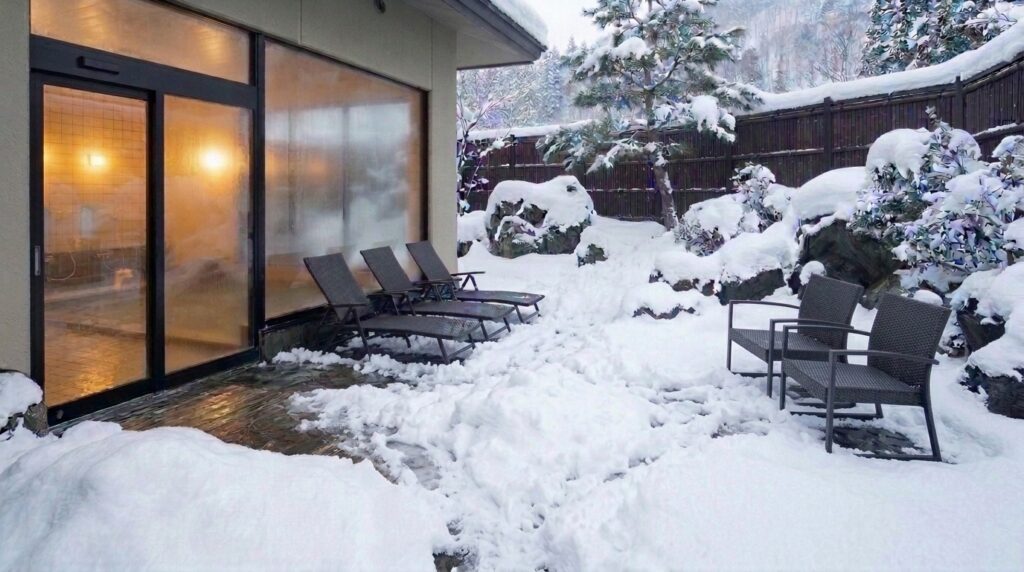
Don’t save a rest chair with your towel for a long time.
Rest chairs are popular and fill up when it’s busy. You can rest standing, on a bench, or inside the bathing area.
When no chair is free, I sometimes dry off well and sit on a chair in the changing room. There’s usually water there, so I can drink something too.
What does “totonou” feel like?
Sauna, cold bath, rest. As you repeat this, your body and mind start to feel light. In Japan, this is called “totonou.”
My usual routine: 10 minutes in the sauna, 3 minutes in the cold bath, and 5 minutes resting outside. I do about 3 rounds.
I love the feeling in the cold bath of the heat deep inside my body slowly cooling down, so I stay in longer than most. (If it’s your first time, start with 30 seconds to 1 minute.)
Honestly, I used to think “totonou” was a vague word. Would I even know it when it happened? But one day, after a proper cold bath and a proper rest outside, it came: like all the strength was draining out through my pores, while my head became clear and sharp.
“Oh, this is it. I’m totonou-ing!”
I got goosebumps.
TV and chatter are part of the sauna too
Many Japanese sauna rooms have a TV. And somehow, it’s often playing a show you’ve never seen.
Sometimes regulars are chatting away. These days, more places ask for mokuyoku, bathing in silence.
Some saunas ask for silence (mokuyoku). Follow the sign.
Quiet saunas are nice. But to me, that slightly strange space with the TV and the chatter is part of the charm of Japanese saunas.
Quick summary: how to use a Japanese sauna
- STEP 1Check that you can use the sauna.
At some places it costs extra and you sign up at the front. Some use wristbands or sauna keys to tell who paid. Many sauna-only facilities are for men only, so women should check first.
- STEP 2Drink some water.
You’ll sweat more than you think.
- STEP 3Wash your body and hair.
Same as at a sento.
- STEP 4Warm up in the bath for a moment.
If your body is cold, it’s harder to sweat. It’s also gentler on your body than going straight from the changing room into the sauna.
- STEP 5Dry off, then go into the sauna.
If you go in wet, you sweat less, and the floor and benches get soaked.
- STEP 6Sit on a sauna mat or a towel.
Take a clean mat from the door. If there are none, use your small towel. Put the used mat in the used basket when you leave.
- STEP 7Stay about 5 to 10 minutes.
That’s only a guide. If you start to feel uncomfortable, get out early. Lower benches are cooler, so start there.
- STEP 8Rinse off your sweat after the sauna.
Use a bucket of water or the shower, starting from your feet. Don’t get into the cold bath sweaty.
- STEP 9Get into the cold bath.
About 30 seconds to 1 minute. Go in slowly, feet first, and sink quietly up to your shoulders.
- STEP 10Rest.
Outside (gaikiyoku) or on a chair. Wipe off the water first.
- STEP 11Repeat 2 to 3 times.
Sauna, cold bath, rest is one round. How many rounds is up to how you feel that day.
- STEP 12Drink water at the end.
You’ve sweated a lot, so drink well.
When things go wrong
The clean mats on the shelf by the door are free to use. When you’re done, put yours in the basket marked “used” or “return.” If you can’t tell, get into a nearby bath and watch what others do when they go into the sauna and when they come out. If you still can’t tell, ask the staff (phrase card 1).
Some places have self-löyly. When water hits the stones, it gets hot fast. If you want to do it, ask the people around you first. The amount and timing are often set by the shop (for example 2 to 3 ladles every 5 to 15 minutes), so check the sign. If someone asks you, “Dōzo” is fine. If it gets too hot, just move down or step out.
Aufguss is really hot. It’s okay to leave in the middle. Open and close the door quickly so the heat doesn’t escape. People often clap at the end, so if you’re still there, join in.
You don’t have to tough it out. Just your feet, or up to your knees, is plenty. If the rinsing water is too cold for you, use lukewarm water. You don’t have to use the cold bath at all. Some places ban putting your head under, so check the sign, and if you’re not sure, don’t.
Rest chairs are popular. Resting standing up, on a bench, or inside the bathing area is fine. You can also dry off well and sit in the changing room, where there’s usually water to drink. When you use a chair yourself, don’t save it with your towel for a long time.
Regulars sometimes kindly offer you the “best seat,” which means the hottest one. Give it a try, and if it’s too much, say “Arigatō gozaimasu” (thank you) and move to a lower bench.
Get out of the sauna or cold bath right away. The bathing area is steamy and warm, so go out to the changing room if you can, sit down, rest, and drink water. Dehydration and burns do happen in saunas. Don’t use the sauna after drinking alcohol or when you feel unwell.
Cheat sheets you can use right away
1. Phrase card for the sauna
Is the sauna included in the price?
サウナは料金に入っていますか?
Sauna wa ryōkin ni haitte imasu ka?
Where are the sauna mats?
サウナマットはどこにありますか?
Sauna matto wa doko ni arimasu ka?
Where do I put used mats?
使ったマットは、どこに置けばいいですか?
Tsukatta matto wa, doko ni okeba ii desu ka?
May I pour water on the stones?
ロウリュしてもいいですか?
Rōryu shite mo ii desu ka?
Sure, go ahead.
どうぞ。
Dōzo.
What time is the Aufguss?
アウフグースは何時からですか?
Aufugūsu wa nanji kara desu ka?
Will a heat master (neppashi) come?
熱波師は来ますか?
Neppashi wa kimasu ka?
2. One round, for your phone
- Wash your body
- Sauna 5–10 min
- Rinse off sweat
- Cold bath 30–60 sec
- Rest
- Repeat 2–3 times
3. The 10-second check before you enter the sauna
- I washed my body and hair
- I dried off
- I drank some water
- I have a sauna mat (or my towel)
- Long hair is tied up
- I know where the clock is (most sauna rooms have a big one)
FAQ
- QCan I talk in the sauna?
- A
Some places ask for mokuyoku (bathing in silence). Even without a sign, keeping it short and quiet is the safe choice.
- QCan I wear a swimsuit?
- A
Saunas in the bathing area of a sento or super sento are used naked. There are mixed saunas where you wear a swimsuit, and those places will say so in their guide.
- QCan I use the sauna if I have a tattoo?
- A
It depends on the place. More places now allow you in if you cover it with a sticker. Check before you go.
- QHow long should I stay in the cold bath?
- A
For your first time, about 30 seconds to 1 minute. Once you’re used to it, stay as long as it feels good. (I stay about 3 minutes.)
- QCan women use Japanese saunas?
- A
Many sento and super sento have a sauna on the women’s side too, but not all of them. Many sauna-only facilities are for men only. Check before you go.
Read next
- Want to know the steps before the sauna, from the entrance to washing? Read How to Use a Japanese Sento.
- Want a quick list of what not to do at a Japanese bath? Read What Not to Do at a Japanese Sento or Onsen.
- Wondering where you can find a sauna, or whether women can go? Read Japanese Bath Types Compared.
I’m Japanese, and I write my drafts in Japanese with help from AI to turn them into natural English. The experiences here are my own. Some photos are AI-generated. If something is unclear, or things are different where you live, please leave a comment below. I’ll reply there, so the next reader can find the answer too.
I also write about Japanese manners in Japanese on note: note.com/enjoyjapan
Sources
- National Consumer Affairs Center of Japan, “Mimamori Shinsen Jōhō No. 548” (August 6, 2026) https://www.kokusen.go.jp/mimamori/pdf/shinsen548.pdf
- FUN! JAPAN, “How to use a sauna and sauna manners” https://www.fun-japan.jp/jp/articles/13728
- Sauna Ikitai, self-löyly manners https://sauna-ikitai.com/advent-calendar/2022/20221205
Comments