

Information as of October 2026.
New here? Please read Start Here first. It explains who I am, and what the colored boxes and speech bubbles in this guide mean.
If you look up manners for Japanese public baths, you find a long list of “don’t do this, don’t do that.” By the time you finish reading, going to one starts to feel a little scary, right?
But it’s really not that hard. Almost all Japanese bath manners come from one simple reason: everyone gets into the same water. Once you understand that, the rest makes sense on its own.
That said, I’ve made mistakes too. In the washing area, I once sprayed the person next to me with my shower and got told off. And when I was a kid, I swam around the bath with a lot of energy…
But mistakes like these are easy to avoid once you know the reason behind them.
So this guide is a short list of the things you really shouldn’t do at a sento (a neighborhood bathhouse) or an onsen (a hot spring bath). At the end, I’ve also written about the things you don’t need to worry about. I hope that part puts your mind at ease.
If you want to learn the whole process from the front desk to the end, start with my step-by-step sento guide.
- Why Japanese baths have these manners: shared water and slippery floors
- What not to do before you go in
- What not to do in the washing area
- What not to do in the bath
- What not to do when you leave
- Can you go to a sento or onsen with a tattoo?
- What you don’t need to worry about at a Japanese bath
- Cheat sheets you can use right away
- Read next
Why Japanese baths have these manners: shared water and slippery floors
In a Japanese bath, you share the same bathtub with strangers. That’s why keeping the water clean matters more than anything.
The other reason is safety. The floor is wet and slippery with soap. The hot water can make you feel dizzy.
Keep these two things in mind, and every item on the list below will make sense.
What not to do before you go in
1. Don’t bathe after drinking
This is less about manners and more about safety. Getting into hot water while drunk can make you collapse. Many places have a sign at the entrance saying they turn away people who are drunk.
Don’t take a bath after drinking alcohol.
2. Don’t take photos or videos
In the changing room (datsuijo) and the bathing area, taking photos is banned almost everywhere. Other people are naked, so it makes sense. Many places don’t even let you bring your phone in. Leaving it in your locker is the safest choice.
No photos or videos in the changing room or the bathing area.
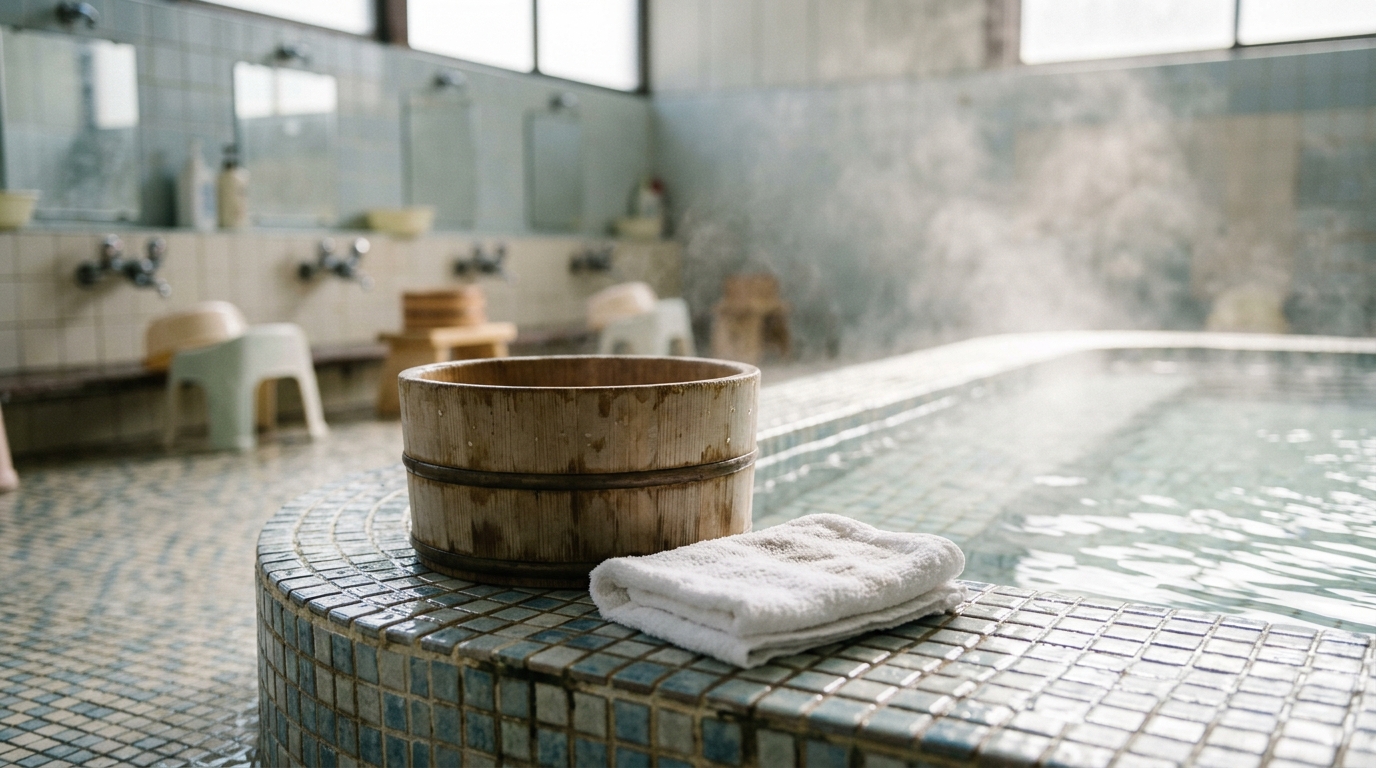
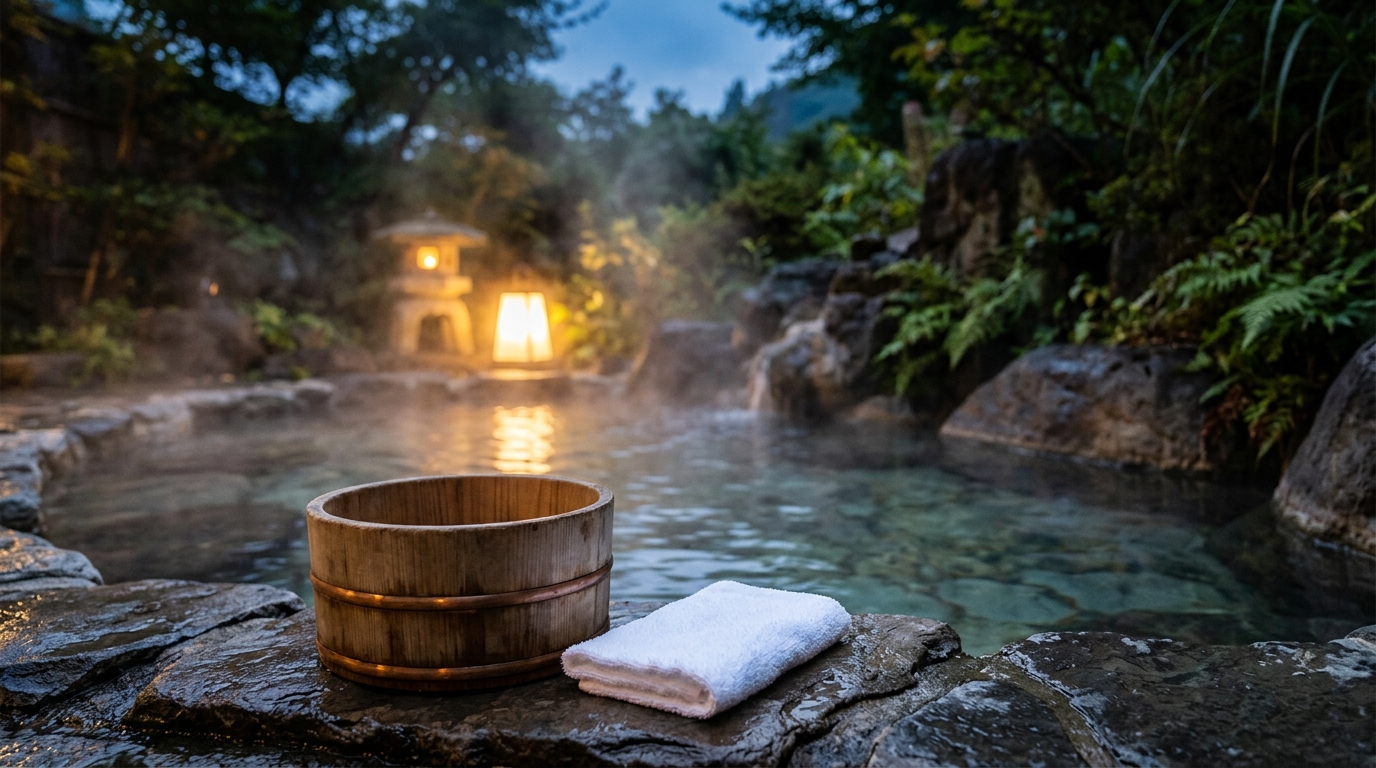
Honestly, the view from an outdoor bath can be so beautiful that I want to take a picture. I always hold back. Take the view home in your memory instead. (All the photos in my articles are AI-generated :D)
What not to do in the washing area
3. Don’t run
The floor is really slippery. Falling is dangerous. I often see kids getting excited, running, and getting told off.
Walk slowly. The floor is slippery.
4. Don’t spray water or soap on the people around you
In the washing area, sit down to wash. If you shower standing up, water and soap fly onto the person next to you.
Sit down to wash, and point your shower away from others.
This is exactly the mistake I made. Before you turn on the shower, just take a second to check which way it’s pointing and who’s next to you.
5. Don’t use the shampoo on the shelf near the entrance
Some bathing areas have a rack (a shelf) near the entrance with small baskets of shampoo and soap on it.
These are other customers’ own things that they brought from home. They’re not supplied by the bathhouse, so don’t use them.
On the other hand, if you bring your own shampoo, you can leave it on that shelf, too.
The shampoo baskets on the shelf belong to other customers. Don’t use them.
What not to do in the bath
6. Don’t get in without washing, or with soap still on you
The bath is not “a place to wash your body.” It’s “a place to warm up a body that’s already clean.” Wash in the washing area first, or at least do kakeyu (pouring hot water over yourself with a bucket) before you get in.
After washing, rinse off all the soap. It often stays on your back or in your hair. Getting in with soap on you makes the water dirty.
Wash first, and rinse off all the soap before you get in.
7. Don’t put your towel in the water
This might be the best-known bath manner of all. Put your towel on your head, or leave it outside the bath. Look around and you’ll probably see someone with a towel on their head. (It’s a little cute.)
Keep your towel out of the water.
8. Don’t let long hair touch the water
Hair works the same way as towels. If your hair is long, tie it up with a hair tie or a clip before you get in.
Tie up long hair so it stays out of the water.
9. Don’t swim or dive
I understand wanting to swim when you see a big bath. (That was me as a kid.) But it splashes water and bothers other people. Putting your head under the water is also a no.
No swimming, and don’t put your head under the water.
10. Don’t talk loudly
Voices echo a lot in the bathing area. Talking with friends is fine, but keep your voice down.
Talking is fine. Just keep it quiet.
What not to do when you leave
11. Don’t leave the changing room wet or messy
Before you leave the bathing area, dry yourself with your small towel, then go back to the changing room. A soaking-wet floor is slippery and dangerous, and it’s not nice for the next person.
Dry yourself before you step into the changing room.
I’ve done this one too. I came out without drying off properly, and the floor ended up soaking wet.
One more thing that bothers me is the washbasins, where people dry their hair. A lot of people leave without cleaning up the hair they dropped. At the very least, rinse it away with water when you’re done. Then the next person can use it happily.
After drying your hair, rinse the hair you dropped off the washbasin.
Can you go to a sento or onsen with a tattoo?
How places handle tattoos is different everywhere. There are:
- places that let you in
- places that let you in if you cover it with a sticker
- places that turn you away
In general, people say neighborhood sento are relatively easy to get into, while many super sento, onsen facilities, and hotel baths turn people with tattoos away.
So the surest way is to check the place’s website before you go, or ask at the front desk before you pay. You can use the phrase card below.
Tattoo policies differ by place. Check the website or ask before you pay.
For what it’s worth, I’ve never met anyone at a bath with a large tattoo across their back. But I do sometimes see people with small, stylish tattoos.
What you don’t need to worry about at a Japanese bath
So far I’ve written about the things not to do. But there are also lots of things you don’t need to worry about.
- Covering yourself or not: You can cover the front of your body with a small towel, or not. Either is fine. Almost nobody is looking.
- Doing things in a slightly different order: As long as you’ve done kakeyu and your body is clean, people don’t care much about the exact order.
- Not staying in long: If it’s too hot, get out right away. It’s not something you have to endure.
- Talking quietly: In a quiet voice, it’s fine to chat with friends or family.
- Regulars talking to you: It happens sometimes. It might surprise you, but it’s almost always just kindness.
In the end, you only need to remember two things: be considerate of the people sharing the water, and don’t get hurt.
Cheat sheets you can use right away
1. Bath don’ts checklist
- Don’t bathe after drinking
- No photos or videos (leave your phone in the locker)
- Don’t run
- Sit down to wash
- Don’t use the shampoo on the shelf (it’s someone else’s)
- Wash before getting in (at least do kakeyu)
- Rinse off all the soap before getting in
- Keep your towel out of the water (on your head or outside the bath)
- Tie up long hair
- No swimming or diving
- Keep your voice down
- Dry yourself before going back to the changing room
- Rinse your hair off the washbasin
- Have a tattoo? Check first
2. Phrase card for the front desk
Save this to your phone and just show the screen.
I have a tattoo. Is it OK to enter?
タトゥーがありますが、入っても大丈夫ですか?
Tatū ga arimasu ga, haitte mo daijōbu desu ka?
Can I cover it with a sticker?
シールで隠せば大丈夫ですか?
Shīru de kakuseba daijōbu desu ka?
Where should I put my phone?
スマホはどこに置けばいいですか?
Sumaho wa doko ni okeba ii desu ka?
Read next
- Want to know the sento steps in order, from the front desk to after your bath? Read How to Use a Japanese Sento.
- Want to know how a sento, super sento, and onsen are different? Read Japanese Bath Types Compared.
I’m Japanese, and I write my drafts in Japanese with help from AI to turn them into natural English. The experiences here are my own. Some photos are AI-generated. If something is unclear, or things are different where you live, please leave a comment below. I’ll reply there, so the next reader can find the answer too.
I also write about Japanese manners in Japanese on note: note.com/enjoyjapan

Comments