

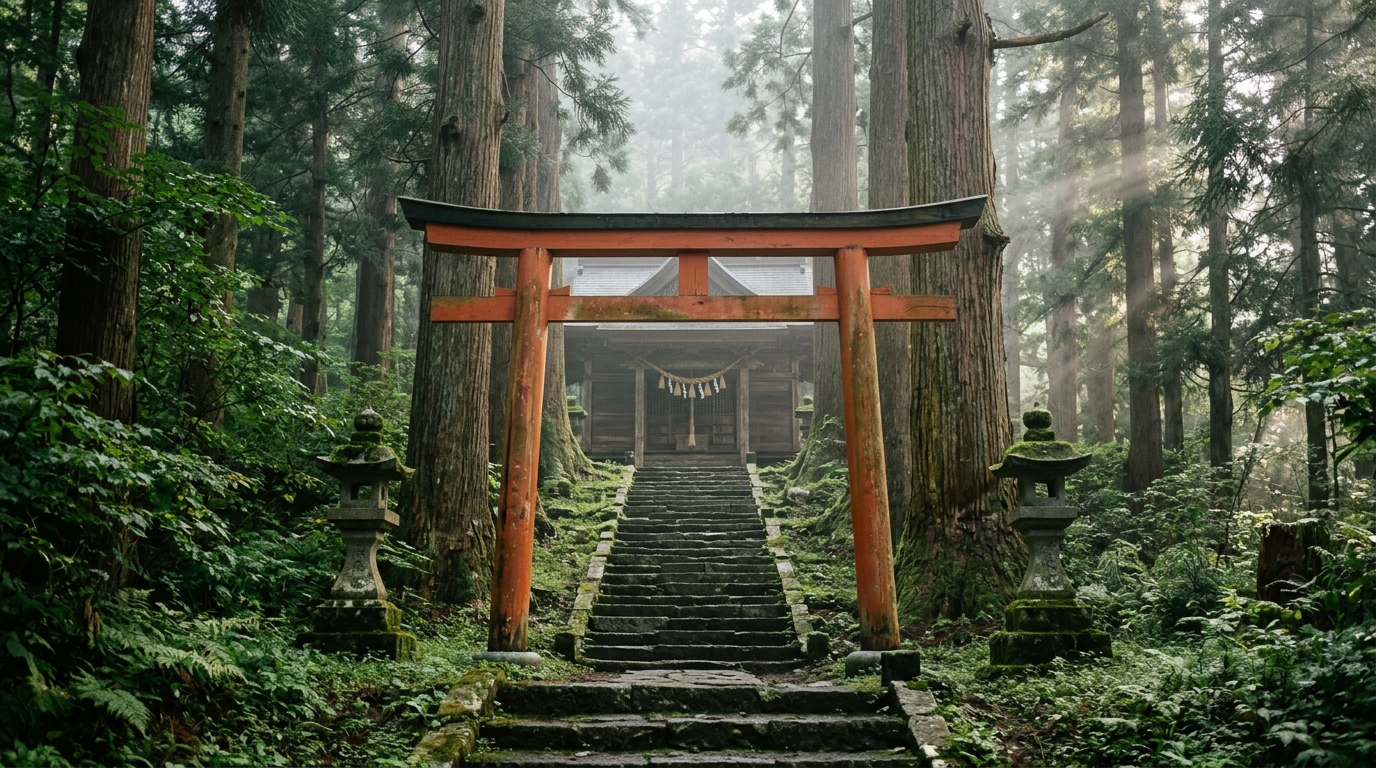
Information as of October 2026.
New here? Please read Start Here first. It explains who I am, and what the colored boxes and speech bubbles in this guide mean.
I live in a small town in the countryside of Tohoku, and there are temples everywhere. On New Year’s Eve, you can hear the joya no kane, the temple bells that ring out the old year, from every direction. There’s a shrine within walking distance, too.
And yet, one day my son asked me something I couldn’t answer.

“Why do we clap at shrines, but not at temples?”
…Good question. I’ve lived in Japan for over 40 years, and at that moment, I had nothing to say.
To be honest, I still get confused sometimes. I always have to stop and think about the order for temizu (washing your hands and mouth before you pray). And once, I almost clapped at a temple.
If a Japanese person gets confused, it’s only natural for a visitor to feel the same. So I looked into it properly. Here’s what I found.
How to tell a shrine from a temple
First, the big picture.
A shrine (jinja) is a place for the kami, the gods of Shinto, Japan’s old native religion. A temple (tera, or otera) is a place for Buddha and Buddhism.
Here’s how to tell them apart when you’re standing in front of one.
| Shrine (jinja) | Temple (otera) | |
|---|---|---|
| Who is worshipped | Kami (Shinto gods) | Buddha |
| Entrance | Torii gate | Sanmon gate with a roof |
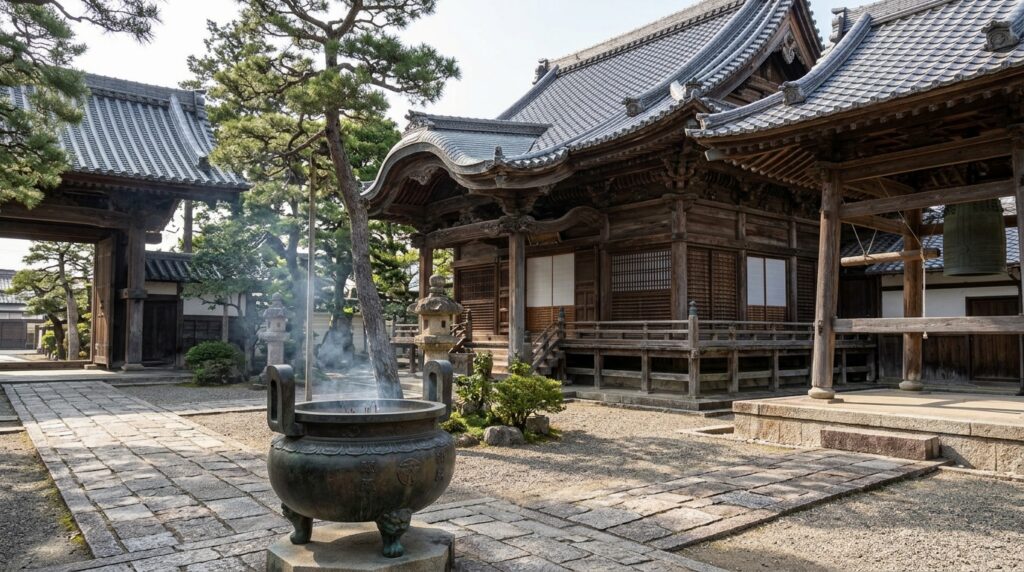
| Things you’ll see | Shimenawa rope, a bell to ring, komainu statues | Incense, Buddha statues, graves, a big bell |
| End of the name | -jinja, -taisha, -jingu, -gu | -ji, -in |
| How to pray | Bow twice, clap twice, bow once | Put your hands together quietly and bow |
A few words from the table:
- Torii: the gate at the entrance of a shrine. Some are bright red (vermilion), some are plain wood or stone.
- Sanmon: the large gate with a tiled roof at the entrance of a temple.
- Komainu: a pair of guardian animal statues facing each other at the shrine entrance.
- Nirei nihakushu ichirei: bow twice, clap twice, bow once. The standard way to pray at a shrine.
- Gassho: putting your palms together in front of your chest.
If you’re not sure, the fastest check is: Is there a torii at the entrance? And how does the name end?
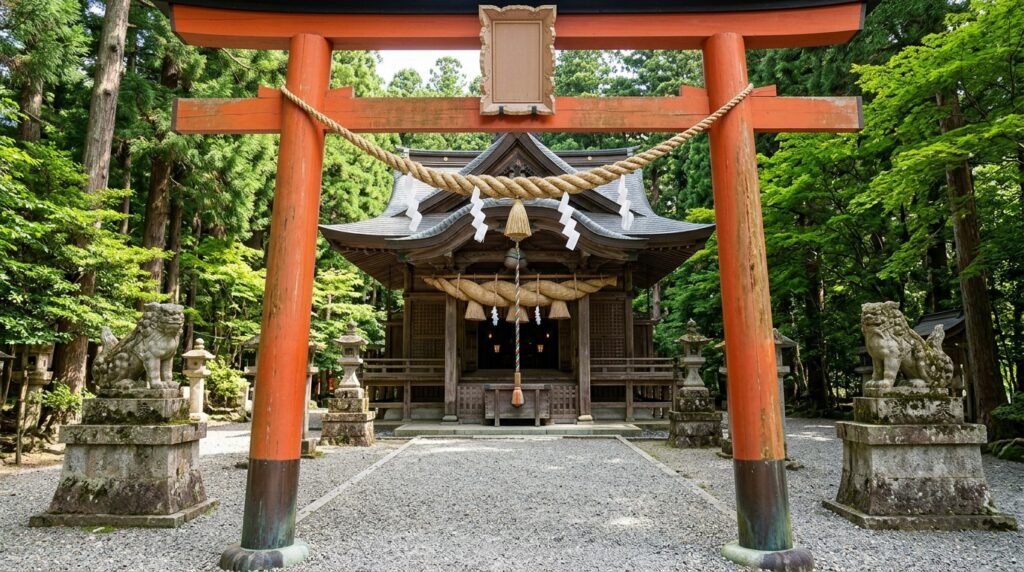
At a shrine, bow twice, clap twice, and bow once.
At a temple, put your hands together quietly and bow. Don’t clap.
Why do you clap at shrines but not at temples?
Here’s the answer to my son’s question. This was the part that surprised me most.
Until the Meiji era (1868–1912), shrines and temples in Japan were mixed together.
People believed in the kami and Buddha at the same time. This is called shinbutsu shugo. It wasn’t unusual to find a temple inside a shrine’s grounds, or a Buddhist monk taking care of a shrine.
And back then, people prayed at shrines the same way they do at temples today: quietly, with their hands together, without clapping. Clapping, called kashiwade, was originally something the shrine priests did.
In the Meiji era, the government officially separated shrines and temples. But the way people prayed didn’t change overnight. Each shrine had its own style, and there was no nationwide standard.
Over a long time, through the Meiji, Taisho, and Showa eras, shrines slowly settled on “bow twice, clap twice, bow once.” It’s said that this became the common way for ordinary visitors only after World War II. Today it’s the standard way to pray at a shrine.
Temples, on the other hand, never had one set way to pray. Putting your hands together is common simply because people have always done it that way.
So here’s the answer I can finally give my son:
“Long ago, shrines and temples were together, and everyone prayed with their hands together. After they were separated, clapping spread at shrines. That’s why today you clap at a shrine, and put your hands together at a temple.”
I don’t know if he’ll remember it, but I finally feel clear about it.
By the way, not every shrine claps twice. At Izumo Taisha in Shimane and Usa Jingu in Oita, the formal way is to clap four times.
Some shrines have their own way of praying. If there’s a sign, follow it.
In the end, “bow twice, clap twice, bow once” and “hands together” weren’t decided by the gods or by Buddha. They’re manners that people built up over time.
A religious studies scholar has written that clapping at a temple “can’t simply be called bad manners,” and that “what matters is praying from the heart.” I think that’s true.
But still. If you clap at a temple, it’s a little embarrassing. Someone nearby might quietly tell you, “We don’t clap at temples.” Your feelings matter most, of course. But in Japan, fitting in with the way things are done in that place matters just as much.
If you know ahead of time “this is what we do here,” you don’t have to worry about getting it wrong. Then you can put your whole heart into your prayer.
What about Inari shrines?
Japan has one more kind of place you’ll probably see: Inari shrines, often called oinari-san. They’re the ones with rows and rows of red torii gates and white fox statues.
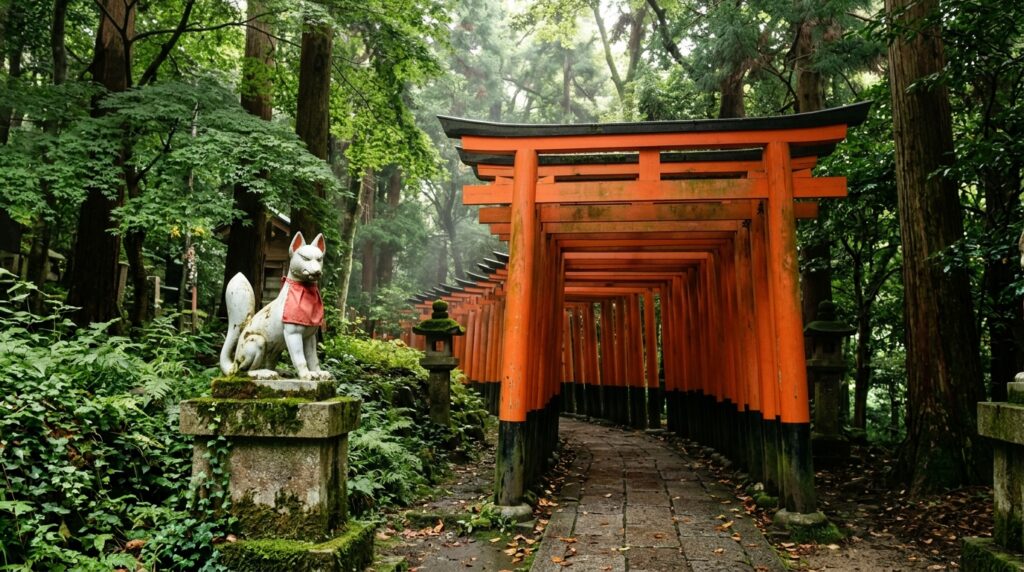
There’s a lot to say about Inari shrines, so I’ll write about them in another guide.
Thank you for respecting the “air” of Japan
One last thing.
I sometimes see visitors from abroad praying at shrines and temples. How to use the temizu, whether to clap or not… I’m sure a lot of it is confusing.
Even so, they walk quietly, watch the people around them, and put their hands together carefully. Even without knowing every rule, you can tell they’re trying to respect the “air” of the place, the quiet feeling that’s there.
Every time I see that, it makes me happy as a Japanese person.
Thank you for always respecting the “air” of Japan.
You don’t have to be perfect from the start. If you’re not sure, just do what the people around you are doing. Even I still get confused sometimes. (・ω<)
Quick summary: shrine or temple
- STEP 1Look at the entrance.
A torii gate means a shrine. A large gate with a roof means a temple.
- STEP 2Check the end of the name.
-jinja, -taisha, -jingu, or -gu means a shrine. -ji or -in means a temple. You can see it on the sign at the entrance or in your map app.
- STEP 3At a shrine, bow twice, clap twice, bow once.
If the shrine posts its own way, follow that.
- STEP 4At a temple, put your hands together quietly and bow.
Don’t clap.
- STEP 5If you’re still not sure, do what others do.
Watch the people around you. Most of all, be quiet and pray from the heart.
When things go wrong
Look for a torii at the entrance, and check how the name ends on the sign or in your map app. If you still can’t tell, it’s fine to ask someone nearby (phrase card 1). Some places, like Inari shrines, can be confusing even for Japanese people.
Don’t worry too much. Just put your hands together, bow, and carry on. Next time you’ll know.
Some shrines and temples have their own way of praying, like Izumo Taisha with its four claps. Follow the sign if there is one, or do what the people around you are doing.
Cheat sheets you can use right away
1. Phrase card for shrines and temples
Is this a shrine or a temple?
ここは神社ですか、お寺ですか?
Koko wa jinja desu ka, otera desu ka?
Should I clap my hands here?
ここでは手を叩きますか?
Koko de wa te o tatakimasu ka?
May I take photos here?
ここで写真を撮ってもいいですか?
Koko de shashin o totte mo ii desu ka?
2. Shrine or temple, for your phone
- Torii gate → shrine
- Roofed gate, incense, big bell → temple
- Shrine: bow 2, clap 2, bow 1
- Temple: hands together, bow, no clapping
- Not sure? Watch the people around you
FAQ
- QDo I have to be religious to visit a shrine or temple?
- A
No. Many Japanese people visit both without thinking of themselves as religious. Just be quiet and respectful.
- QCan I visit a shrine and a temple on the same day?
- A
Yes. Many people do, especially at New Year. Just switch the way you pray: clap at the shrine, hands together at the temple.
- QIs it bad manners to clap at a temple?
- A
Some scholars say it can’t simply be called bad manners. But it isn’t the usual way, and people may notice. Putting your hands together quietly is the safe choice.
- QWhy do some shrines clap four times?
- A
Some shrines, such as Izumo Taisha and Usa Jingu, keep their own traditional way of praying. If a shrine shows its own way on a sign, follow it.
Read next
- Want to try another everyday Japanese manner? Read How to Use a Japanese Sento.
- Guides on how to pray at a shrine, at a temple, and at an Inari shrine are coming next.
I’m Japanese, and I write my drafts in Japanese with help from AI to turn them into natural English. The experiences here are my own. Some photos are AI-generated. If something is unclear, or things are different where you live, please leave a comment below. I’ll reply there, so the next reader can find the answer too.
I also write about Japanese manners in Japanese on note: note.com/enjoyjapan
Sources
- nippon.com, “Is clapping at a temple bad manners? A look at the history of shinbutsu shugo” (Japanese) https://www.nippon.com/ja/japan-topics/g02571/
- nippon.com, on the number of claps at shrines such as Izumo Taisha and Usa Jingu (Japanese) https://www.nippon.com/ja/views/b05207/
- AJALT, “Shrines and temples” (how to pray at each, Japanese) https://www.ajalt.org/file/jinja.pdf
- President Online, on how “bow twice, clap twice, bow once” spread from the Meiji to the Showa era (Japanese) https://president.jp/articles/-/89498

Comments